Introduction
Syriac music has a long and rich history that spans centuries and continents. This tradition and musical culture found its way to India, where it obtained a permanent home in a land culturally and musically fertile land. The acceptance of the Syriac Christian musical tradition in India was due to centuries of cultural diversity, musical wealth and an open and welcoming attitude. India is a land with a rich variety of indigenous music, art, architecture, medicine, astrology, astronomy, geology, and philosophy. India as a land of spirituality brought forth great ascetics and hermits who spent their time in meditation and in prayer. India s the birth place of major religions like Hinduism, Buddhism, Jainism and Sikhism, as well as a home to Christianity and Islam. India is the home of sage Bharata who systematized the theory of dance she is the home of Kalidasa the great poet, and great philosophers like Nagarjuna, Madhwa, Sankaracharya and Sri Rama Paramahamsa. It is the land of profound literature, like the Vedas and Puranas, epics like the Ramayana and Mahabharata and great philosophical writings like the Upanishads.
Vedic chanting is part of this history and is recognized a5 the a beginning of the corporate spiritual singing tradition in India, in Which the ancient scriptures. Vedas, were not sung, but chanted. Indians discovered the octaves (sapta swara), or eight notes system during the classical period (2nd — 3rd century B.C.). It is recorded that Indian musicians of the Vedic period first discovered twenty-two semi tones in an octave (sthai). Later musicians developed an advanced theory that an octave (sthai) consisted of forty-four srutis. The plethora of musical advancements and cultural influences represent the ingenuity and fertility of India as a land ready to adopt the rich Syriac musical tradition which possessed great depth, meaning, and beauty as its own.
Importance of Syriac Music
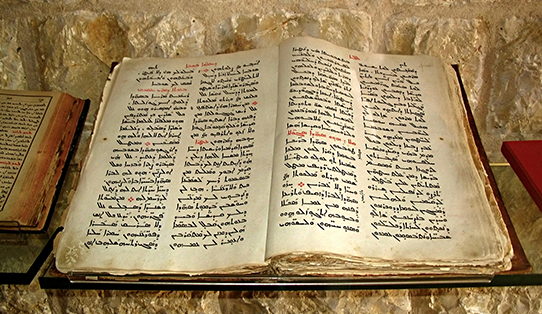
The Syriac language is well known for its style of presentation, mode of construction as well as its musical tradition, which is evident in the daily liturgical life of the Indian Syrian Christians. Why did the Indian Syrian Christians eventually hold it in such high esteem? It is most likely the combination of the solemnity of Syriac music, the nobility of its contents and vitality of its elements in worship (bhakti) were responsible for the high esteem accorded to it.
Syriac music is considered to be one of the most important ecclesiastical chants among the ancient Christian churches. Also, Syriac occupies a place of respect within Christianity because it is a dialect of Aramaic the mother tongue of Jesus. The Syriac language, which used to be widespread, is at present almost exclusively a liturgical or sacred language similar to the Sanskrit language in India.
Today, only a small number of East and West Syrian communities actively use the Syriac language in their liturgical worship life. The syriac chant also represents a treasure house of theological wisdom from the perspective of the Syriac tradition. The writings of the Syrian Fathers are one of the key sources of Eastern theology and worship in the church. The Syriac tradition contributed a great deal towards Christian literature from the 2nd Century A.D onwards. The 4th Century is considered to be the golden period of the universal Christian Church in faith, theology, liturgy and music, which holds true for the Syriac tradition as well. Fathers like Aphrahat, Ephrem, Jacob of Serug, Mar Ba‘lai of Aleppo, Simon Quqoyo’, and Severios of Antioch among others are considered as the pioneers of Syriac literature, poetry, liturgy and theology. The emphases of their writings were primarily theological social, ethical, and spiritual.
The profound expressions of theological ideas through the Poetic structure of the Syriac language by the Fathers is particularly noteworthy. The theologically rich and impassioned defenses of the Orthodox faith against the increasing number of heretical teachings marked the height of theological profundity and creative expression in the Syrian tradition.